Real Estate8/17/2026
Dubai's real estate market remained highly active in July 2026, but the most important story was not simply how many properties changed hands.
The emirate recorded 13,872 property sales worth approximately AED 34.5 billion, while the market-wide average price reached around AED 1,680 per square foot.
Transaction volume softened compared with the previous month, yet the overall value of property sold increased. That combination tells us something important about the current market: buyers may be becoming more selective, but significant capital is still moving into Dubai real estate.
July also highlighted several wider trends:
- Apartments continued to generate most transaction activity
- Off-plan developments remained the dominant sales segment
- Properties below AED 2 million attracted the broadest buyer base
- Cash purchasers continued to play a major role
For PARK Properties, however, the citywide numbers are only part of the picture.
This report goes beyond Dubai's headline statistics to examine what July's transactions may mean for buyers and investors before taking a closer look at Warsan 4, where local pricing, transaction activity and rental yield reveal a particularly interesting affordability story.
Dubai Property Market July 2026 at a Glance
|
Market Indicator |
July 2026 |
|
Total Property Transactions |
13,872 |
|
Total Sales Value |
AED 34.5 Billion |
|
Average Price per Sq. Ft. |
AED 1,680 |
|
Off-Plan Transactions |
9,585 |
|
Secondary Transactions |
4,287 |
|
Off-Plan Share |
69% |
|
Secondary Market Share |
31% |
|
Cash Purchases |
67% |
|
Mortgage Purchases |
33% |
|
Largest Buyer Price Segment |
Below AED 1 Million |
The headline figures point towards a market that remains liquid and diverse, but looking at transaction value alongside volume reveals a much clearer picture of buyer behaviour.
What Happened in Dubai's Property Market in July 2026?
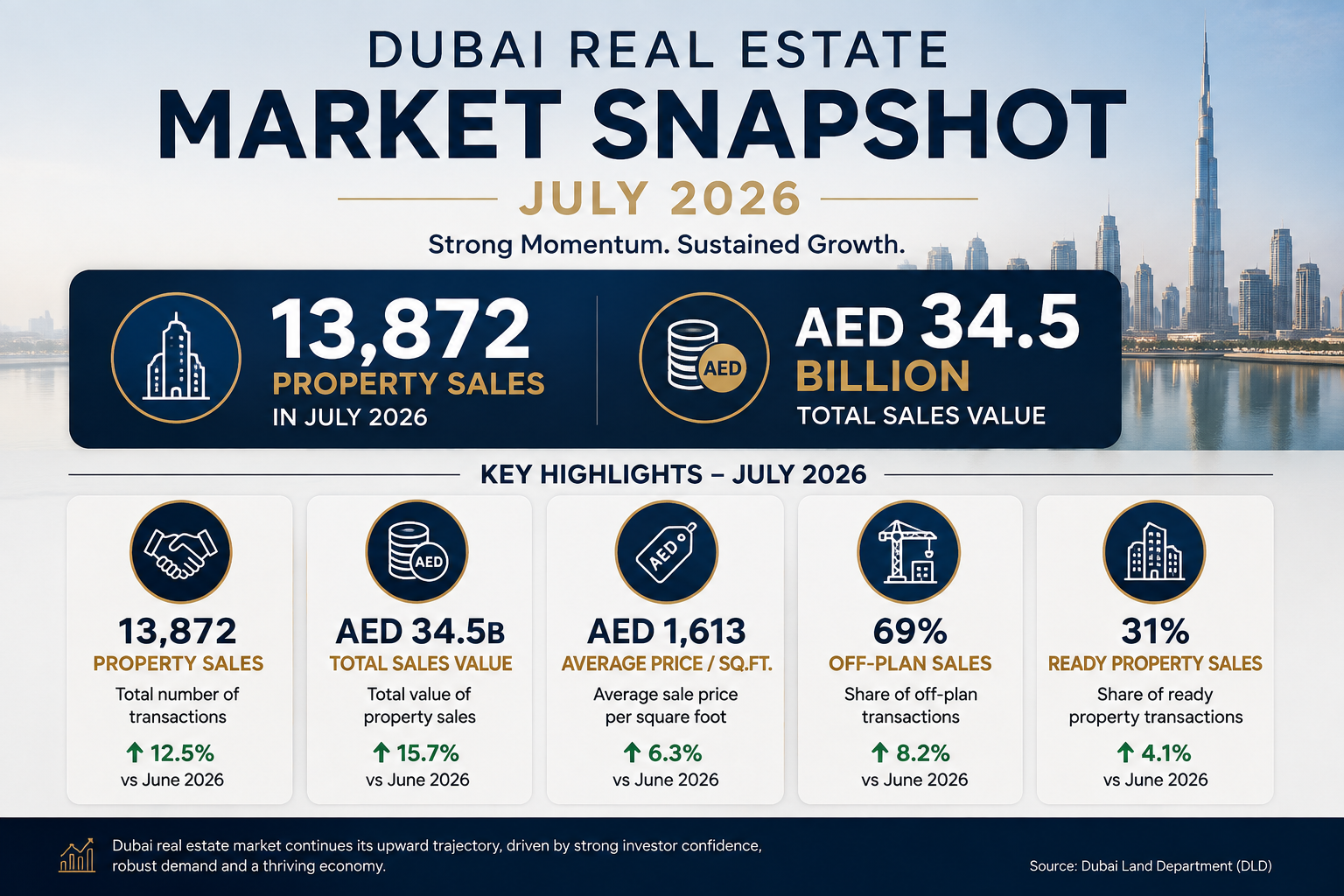
Dubai recorded 13,872 real estate transactions during July, generating approximately AED 34.5 billion in total sales value.
Based on these rounded market figures, this represents an implied average transaction value of approximately AED 2.49 million per sale.
That does not mean the average Dubai property actually costs AED 2.49 million. Luxury properties, land transactions and high-value villas significantly influence total transaction value.
What the figure does show is how much capital continued to flow through Dubai's property market despite a softer transaction count.
This is particularly important when assessing whether Dubai is entering a slowdown.
Looking only at the number of sales might suggest weaker activity. Looking at value, price per square foot, property categories and transaction composition produces a different conclusion.
July appears to have been a month of greater buyer selectivity rather than a broad withdrawal from Dubai real estate.
Capital remained active; buyers were simply distributing it differently across the market.
Apartments Continued to Dominate Dubai Property Transactions
Apartments remained by far the most frequently traded property type during July.
|
Property Type |
Transactions |
Sales Value |
|
Apartments |
11,759 |
AED 17.8B |
|
Villas |
1,322 |
AED 7.8B |
|
Commercial Properties |
515 |
AED 1.9B |
|
Plots |
268 |
AED 6.9B |
Approximately 85% of July's transactions were apartments.
However, apartments contributed only around half of the total property sales value.
This difference is important.
Dubai's apartment market provides enormous transaction liquidity because apartments offer entry points across multiple budget levels, from affordable studios and one-bedroom homes to premium branded residences.
Villas and plots, by comparison, generate fewer transactions but considerably larger individual deal values.
Land provides perhaps the clearest example.
Only 268 plot transactions were recorded, yet they generated approximately AED 6.9 billion in sales value.
That means a relatively small number of transactions can have a substantial impact on Dubai's total monthly real estate value.
For buyers and investors, transaction count should therefore never be considered alone. The type, price and location of the properties being sold are equally important.
Which Property Price Range Was Most Popular in July?
Perhaps one of the most useful signals for residential investors came from Dubai's transaction distribution by price.
|
Property Price |
Share of Transactions |
|
Below AED 1 Million |
43% |
|
AED 1M – AED 2M |
30% |
|
AED 2M – AED 3M |
11% |
|
AED 3M – AED 5M |
8% |
|
Above AED 5M |
7% |
The most significant number here is not Dubai's luxury segment.
It is the 73% of transactions taking place below AED 2 million.
Properties priced under AED 1 million alone accounted for approximately 43% of July sales, making this the largest individual transaction bracket in the market.
Dubai remains globally recognised for luxury villas, penthouses and branded residences, but the July data shows that the city's property market is supported by a much broader buyer base.
Affordable and mid-market homes continue to provide much of Dubai's transaction liquidity.
For investors, this is especially relevant when assessing developing residential locations such as Warsan 4, where entry prices remain considerably lower than in many mature central Dubai communities.
Off-Plan vs Ready Property: Which Market Was Stronger?
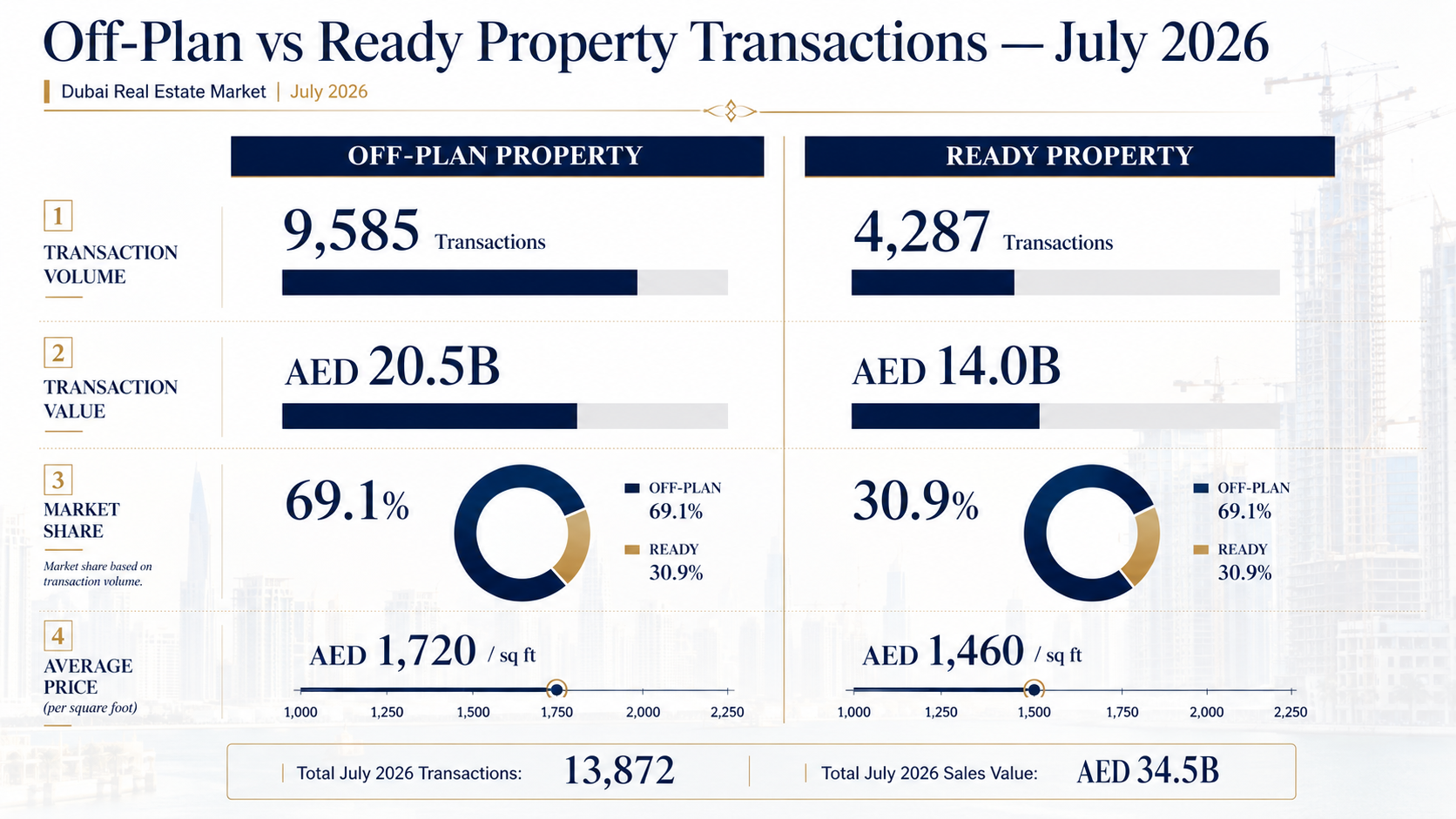
Off-plan real estate continued to dominate Dubai in transaction volume during July 2026.
|
Market Segment |
Transactions |
Sales Value |
Avg. Price/Sq. Ft. |
|
Off-Plan |
9,585 |
AED 20.5B |
AED 1,720 |
|
Secondary |
4,287 |
AED 14B |
AED 1,460 |
Approximately 69% of all property transactions were off-plan, compared with 31% in the secondary market.
At first glance, this makes off-plan property the obvious market leader.
But the sales-value numbers reveal a more nuanced picture.
Off-plan transactions generated around AED 20.5 billion, while the significantly smaller pool of secondary transactions generated approximately AED 14 billion.
Based on the rounded totals, the implied value per transaction works out at roughly:
- Off-plan: AED 2.14 million per transaction
- Secondary: AED 3.27 million per transaction
This suggests the two markets are serving different buyer objectives.
Off-plan property continues to attract buyers through new project launches, phased payment structures, lower initial cash requirements and the potential for capital appreciation during development.
Completed properties attract buyers who may be willing to commit more capital to obtain immediate possession, established rental history, developed surroundings or a home they can occupy without waiting for construction.
Therefore, the question for buyers should not simply be:
"Is off-plan better than ready property?"
A more useful question is:
"Which structure better matches my investment timeline, capital and intended return?"
Why Off-Plan Property Remains So Important in Dubai
Off-plan's 69% share of July transactions demonstrates how heavily new development continues to influence Dubai's residential market.
Flexible payment structures are a major reason.
Instead of paying the majority of the purchase price immediately, buyers can often spread payments across construction milestones or, in some cases, post-handover periods.
That increases accessibility for investors who want property exposure without committing the full purchase value at once.
New developments also frequently include modern layouts, smart-home features, lifestyle amenities and contemporary community planning.
However, a high-volume off-plan market also makes due diligence more important.
Buyers should consider:
The developer's track record
- Construction progress
- Project location
- Competing supply
- Payment structure
- Expected completion
- The realistic rental market after handover
A strong Dubai market does not automatically make every individual development a strong investment.
Which Areas Attracted the Most Off-Plan Buyers?
July's leading off-plan communities reflect Dubai's continued expansion towards major development corridors.
Among the strongest areas were:
|
Rank |
Area |
Approx. Transactions |
|
1 |
Dubai South |
2,231 |
|
2 |
Jebel Ali |
868 |
|
3 |
Wadi Al Safa 4 |
677 |
|
4 |
Al Barsha South Fourth |
535 |
|
5 |
Jabal Ali First |
473 |
Dubai South stands out particularly strongly.
Its performance reflects growing buyer attention towards areas supported by major infrastructure investment, master-planned communities and future economic development.
But transaction volume does not automatically equal investment quality.
A community recording thousands of transactions can also have a considerable future supply pipeline.
Investors should therefore assess future competition as carefully as current demand.
Which Areas Were Active in the Secondary Market?
The ranking changes considerably when completed properties are considered.
|
Rank |
Area |
Approx. Secondary Sales |
|
1 |
Al Barsha South Fourth |
417 |
|
2 |
Business Bay |
323 |
|
3 |
Dubai Marina |
268 |
|
4 |
Al Merkadh |
184 |
|
5 |
Jabal Ali First |
181 |
This difference between off-plan and ready-market activity highlights an important characteristic of Dubai real estate.
There is no single "Dubai property buyer".
Someone purchasing an off-plan apartment in an emerging community may have completely different priorities from a buyer acquiring a completed residence in Business Bay or Dubai Marina.
Understanding those differences is increasingly important as Dubai's market matures.
Cash Buyers Continued to Lead the Market
Another notable July trend was the continued strength of cash buyers.
Approximately:
- 67% of purchases were cash transactions, while
- 33% involved mortgage financing.
A high proportion of cash buying provides additional perspective on the strength of Dubai's market.
It indicates that property demand is not entirely dependent on easy borrowing or highly leveraged purchases.
At the same time, mortgages still account for roughly one-third of buyer activity, making financing conditions important for both end-users and investors.
The balance creates two meaningful demand pools: buyers deploying available capital and buyers using financing to acquire homes or investment properties.
Is the Dubai Real Estate Market Slowing Down?
This is one of the most important questions investors are asking in 2026.
And the answer depends on what is meant by "slowing down".
A reduction in monthly transaction volume does not automatically mean prices are falling or buyers are leaving the market.
July showed precisely why.
Transaction volume softened, yet total transaction value increased and the overall market price per square foot remained relatively resilient.
Instead of viewing July as evidence of a broad correction, it may be more appropriate to describe the market as entering a more selective phase.
During extremely strong growth periods, buyers can sometimes benefit simply from being exposed to the wider market.
As markets mature, the difference between a good property and an average property becomes more important.
Location, entry price, payment structure, developer credibility, rental demand and future supply increasingly determine performance.
For investors, that shift can actually create opportunity.
What July 2026 Tells Us About Dubai Property Buyers
Three patterns stand out particularly clearly.
- First, affordability remains extremely important.
- Nearly three-quarters of transactions occurred below AED 2 million.
- Second, buyers continue to favour new property.
- Almost seven out of ten transactions were off-plan.
- Third, buyers are still willing to deploy substantial capital.
- Despite softer monthly sales volume, overall transaction value remained strong.
Together, these trends suggest that accessible entry prices combined with attractive payment structures remain among the strongest drivers of demand.
That becomes particularly relevant when examining emerging communities.
And one area worth looking at more closely is Warsan 4.
Warsan 4 Real Estate Market: July 2026 Performance
Dubai-wide reports are useful for understanding overall market direction.
But an investor ultimately buys a property in a specific building, within a specific neighbourhood, at a specific price.
That makes community-level analysis much more actionable.
According to the July 1–31, 2026 Warsan Fourth market data reviewed for this report, the area recorded the following:
|
Warsan 4 Market Metric |
July 2026 |
|
Median Property Price |
AED 832,000 |
|
Median Price per Sq. Ft. |
AED 1,250 |
|
Transactions |
167 |
|
Rental Yield |
9% |
|
Median Price Change |
+8% |
|
Price/Sq. Ft. Change |
+20% |
|
Transaction Change |
-44% |
These numbers tell an interesting story.
Warsan 4 recorded fewer transactions during the comparison period, yet its median property price increased by 8% and median price per square foot increased by 20%.
That does not mean every property in the community appreciated by those percentages.
Monthly median figures can be influenced by the type, size and quality of units sold.
However, the numbers do show that lower transaction volume did not prevent transactions from taking place at stronger median pricing levels.
For an emerging residential market, that is worth monitoring.
Dubai vs Warsan 4: How Does the Area Compare?
One of the most useful comparisons is price per square foot.
|
Metric |
Dubai |
Warsan 4 |
|
Price per Sq. Ft. |
AED 1,680 |
AED 1,250 |
|
July Transactions |
13,872 |
167 |
|
Warsan 4 Median Property Price |
— |
AED 832,000 |
|
Reported Warsan 4 Rental Yield |
— |
9% |
Warsan 4's median price of AED 1,250 per sq. ft. was approximately 26% lower than Dubai's AED 1,680 market-wide figure during July.
That price gap is potentially significant for buyers seeking entry into Dubai's residential market without paying the pricing associated with more established central locations.
It also places Warsan 4 firmly within another important market trend.
The area's AED 832,000 median transaction price sits inside Dubai's largest buyer segment properties below AED 1 million.
Remember that approximately 43% of Dubai's July property transactions occurred within this price bracket.
That creates a logical connection between the wider Dubai market and Warsan 4's current positioning.
Why Warsan 4 Is Becoming Relevant to Property Investors
Warsan 4's appeal is primarily based on accessibility.
Instead of competing directly with premium areas such as Downtown Dubai, Dubai Marina or Palm Jumeirah, the community serves a different part of the market.
Its lower acquisition costs can make it relevant to:
- First-time property buyers
- Investors seeking affordable apartments
- Purchasers prioritising rental yield over luxury positioning
The reported 9% rental yield in the supplied July market snapshot is particularly noteworthy.
As always, headline yield figures should be treated as market indicators rather than guaranteed investment returns.
Actual yield depends on the purchase price, achieved rent, occupancy, service charges, maintenance expenses and the exact property selected.
However, the figure demonstrates why affordable residential communities continue to attract investor attention.
Lower purchase prices can create the potential for stronger percentage yields when rental demand remains healthy.
Why Entry Price Matters More Than Ever
July's Dubai-wide data and Warsan 4's community statistics point towards the same theme:
Entry price matters.
With 43% of Dubai transactions occurring below AED 1 million, investors are clearly not concentrating exclusively on luxury property.
There remains substantial demand for projects that provide access to Dubai real estate at achievable price points.
That does not mean buyers should simply choose the cheapest property available.
Value should be assessed by comparing:
- Purchase price
- Usable area
- Price per square foot
- Payment structure
- Location
- Expected rental demand
- Competing developments
- Developer quality
For buyers evaluating Warsan 4, project-level analysis becomes the next step.
Where PARK Residency Fits Into the Warsan 4 Market
One project that naturally fits within this affordability discussion is PARK Residency by PARK Group.
Located in Warsan 4, PARK Residency offers studio, one-bedroom and two-bedroom apartments, providing different entry points for both residential buyers and investors.
The development has been introduced with prices starting from approximately AED 584,014, placing its starting entry point below the AED 832,000 median property price recorded across Warsan 4 in July 2026.
The comparison needs to be interpreted correctly.
An area's median transaction price includes different developments, property sizes, specifications and unit configurations. It should therefore not be used as a direct valuation of PARK Residency.
What it does provide is useful market context.
A starting price of approximately AED 584,014 places PARK Residency within the sub-AED 1 million segment that generated the greatest transaction activity across Dubai in July.
That makes the development relevant to the affordability trend currently visible in Dubai's wider residential market.
Can Payment Plans Influence Off-Plan Demand?
July's 69% off-plan transaction share shows how strongly Dubai buyers continue to respond to new developments.
Payment structure is one reason.
PARK Residency provides an example of this approach, with a structure that includes an initial payment and phased instalments designed to spread the purchase commitment across the development period.
For buyers, this can reduce the amount of capital required at the beginning of an investment compared with purchasing a completed property outright.
However, investors should evaluate a payment plan based on the overall purchase price rather than simply the size of each instalment.
A convenient payment structure is valuable only when the underlying property also makes sense.
What Could Drive Warsan 4 in the Coming Years?
The long-term case for an emerging community is rarely determined by one month of property transactions.
Development maturity matters.
As residential communities expand, the addition of transportation links, retail, schools, services, public spaces and improved road connectivity can affect how residents perceive an area.
This is why infrastructure development should form part of any long-term Warsan 4 investment assessment.
For buyers researching the area, PARK Properties' analysis of the Dubai Metro Blue Line's potential impact on Warsan Fourth provides additional context around future connectivity and how infrastructure could affect the community's appeal.
Investors should nevertheless avoid assuming that infrastructure automatically guarantees capital appreciation.
Property pricing, supply and demand must continue to support the investment case.
What Should Buyers Watch During the Rest of 2026?
Dubai's July figures give investors several indicators to monitor over the coming months.
- The first is transaction volume.
- If volumes stabilise while prices remain resilient, it may provide evidence that Dubai is successfully moving from rapid expansion towards a more mature phase.
- The second is off-plan supply.
- With 69% of transactions occurring off-plan, future project delivery will be important. Large volumes of new apartments entering individual communities can influence rents and resale competition.
- The third is affordability.
- If sub-AED 2 million properties continue to dominate transaction activity, affordable and mid-market communities could remain highly relevant.
- The fourth is rental performance.
- For investors purchasing specifically for income, rental growth and occupancy ultimately matter more than headline sales figures.
And finally, investors should increasingly monitor individual communities instead of relying entirely on Dubai-wide averages.
What Does July 2026 Mean for Dubai Property Investors?
July reinforces the idea that Dubai is no longer one uniform property market.
It is a collection of multiple markets operating simultaneously.
- Luxury residences attract global capital.
- Affordable apartments generate transaction liquidity.
- Off-plan developments provide structured entry opportunities.
- Completed homes attract buyers seeking immediate use.
- Established communities offer proven rental markets.
- Emerging areas offer lower entry prices and potential future upside.
The right choice therefore depends on the investor.
For someone focused on capital preservation, an established completed property may be suitable.
For an investor prioritising affordability and phased payments, off-plan developments may be more relevant.
For someone seeking rental income, community-level rents and net yield become central to the decision.
There is no universal answer.
The objective is to match the property with the investment strategy.
Final Outlook: Dubai Real Estate After July 2026
Dubai's property market remained fundamentally active during July 2026, recording 13,872 transactions worth approximately AED 34.5 billion.
Apartments dominated transaction volume, off-plan properties represented approximately 69% of transactions and the market remained heavily concentrated below AED 2 million.
Perhaps most importantly, total sales value remained strong despite softer transaction volume.
That suggests capital has not disappeared from Dubai real estate.
Instead, buyers appear to be becoming more selective about where and how they invest.
And that makes local market intelligence increasingly valuable.
Warsan 4 provides a useful example.
With a July median property price of approximately AED 832,000, median pricing around AED 1,250 per square foot and an indicated rental yield of 9%, the community sits within the affordability segment responsible for much of Dubai's transaction activity.
Projects such as PARK Residency provide investors with another way to evaluate that trend at development level, particularly given its entry pricing relative to the wider Warsan 4 market.
The broader lesson from July is therefore straightforward:
Dubai real estate remains active, but future performance will increasingly depend on buying the right property at the right price — not simply buying because it is in Dubai.
Data & Methodology
This market report uses July 2026 Dubai real estate transaction figures provided through the market research reviewed for this article, including Dubai Land Department-related transaction reporting and comparative industry market reports.
Warsan 4 figures are based on the supplied DXB Interact market snapshot covering 1 July to 31 July 2026.
PARK Properties has used these figures to provide additional market interpretation and community-level comparisons.
Market statistics, median prices, average prices and rental yields should be used as research indicators rather than as guaranteed future returns or independent property valuations. Property performance varies according to building, unit size, floor, view, condition, purchase price, service charges and market conditions.
Frequently Asked Questions
Q1: How many Dubai real estate transactions were recorded in July 2026?
Ans: Dubai recorded approximately 13,872 property sales in July 2026, generating around AED 34.5 billion in total sales value.
Q2: What was the average property price per square foot in Dubai in July 2026?
Dubai's overall market price was approximately AED 1,680 per square foot during July 2026.
Q3: Were off-plan properties more popular than ready properties?
Yes. Approximately 69% of July transactions were off-plan, while around 31% were secondary-market property sales.
Q4: What was the most popular property price range in Dubai?
Properties priced below AED 1 million represented approximately 43% of July transactions, making them the largest individual price category.
Q5: How many Dubai property transactions were below AED 2 million?
Approximately 73% of July transactions occurred below AED 2 million when the below-AED 1 million and AED 1–2 million categories are combined.
Q6: How did Warsan 4 perform in July 2026?
Warsan 4 recorded 167 transactions, with a median property price of approximately AED 832,000 and a median rate of around AED 1,250 per square foot.
Q7: What was the rental yield in Warsan 4?
The July 2026 market snapshot showed an indicated rental yield of approximately 9% for Warsan 4. Actual property-level yields can vary considerably.
Q8: Is Warsan 4 cheaper than the Dubai average?
Based on the July figures reviewed, Warsan 4's AED 1,250 median price per square foot was approximately 26% below Dubai's AED 1,680 market-wide figure.
Q9: Is PARK Residency located in Warsan 4?
Yes. PARK Residency by PARK Properties is located in Warsan 4 and includes studio, one-bedroom and two-bedroom apartments.
Q10: What is the starting price of PARK Residency?
PARK Residency has been introduced with prices starting from approximately AED 584,014, subject to unit availability and current developer pricing.