Real Estate19 November 2026
Updated November 2026 · Park Properties analysis of Dubai Land Department (DLD) transaction data
Most Dubai property guides quote a rental yield of 6 to 7% and stop there. That number is not what you keep. Once you pay the 4% DLD transfer fee, agency commission, service charges, vacancy and the cost of selling, the picture changes.
To show how you can build wealth through Dubai real estate, and what a five-year investment really looks like after costs, we built one complete example: a AED 1.2 million ready apartment, held for five years, with every fee counted. We then ran it through five price scenarios, compared cash with a mortgage, and tested it against every five-year period in DLD price data since 2012.
Key takeaways
- Gross yield is not income. A 6.5% gross yield becomes about 4.3% net after service charges, management, maintenance, vacancy and insurance.
- Getting in and out costs about 9% of the price. On a AED 1.2M apartment that is roughly AED 78,000 to buy and AED 34,000 to sell, so five years is close to the minimum sensible hold.
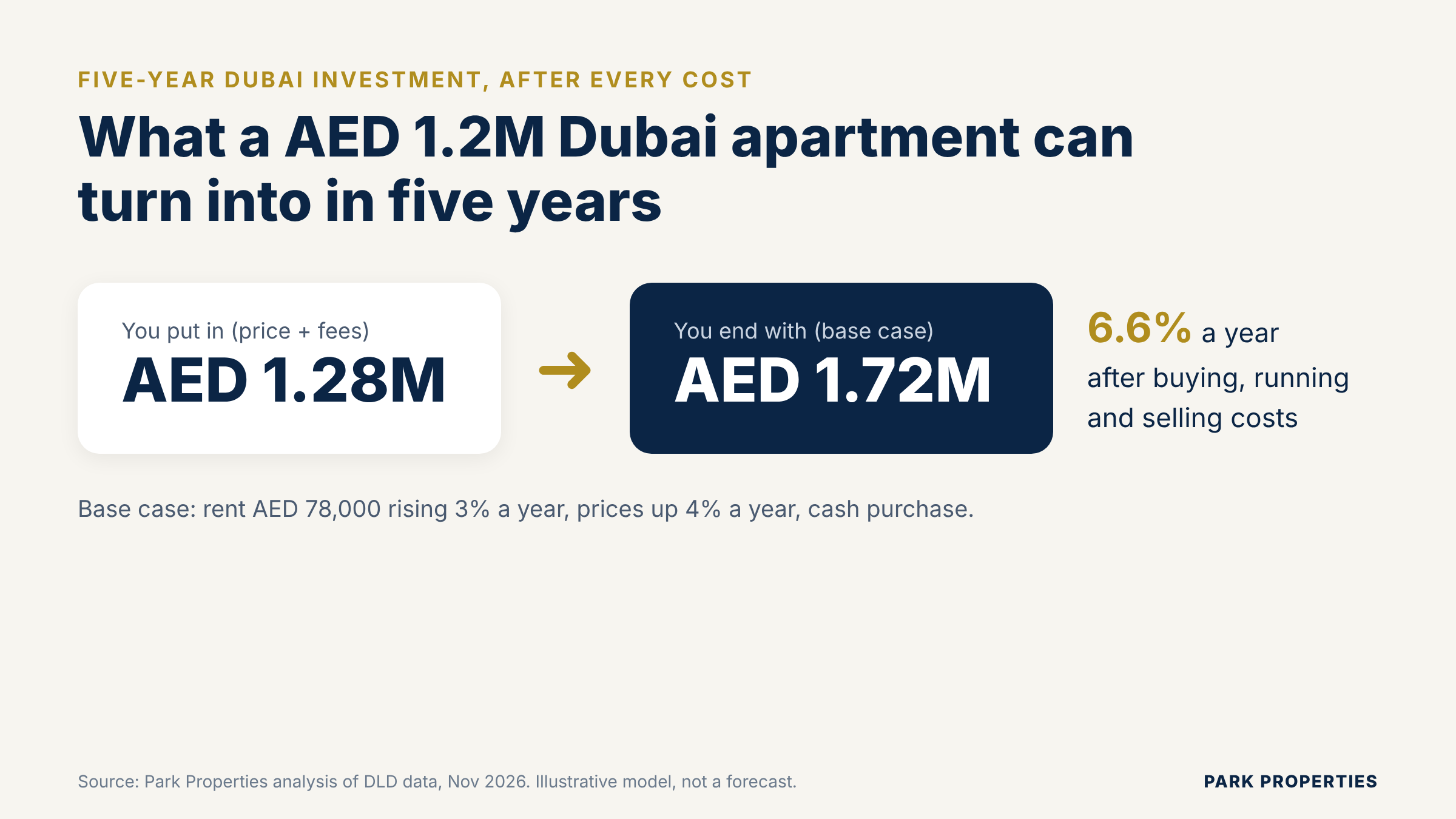
- Base case: about 6.6% a year in cash. If prices rise 4% a year, AED 1.28M invested becomes about AED 1.72M after all costs (about USD 469,000).
- A mortgage magnifies both sides. With 80% financing the base case returns 11.2% a year, but flat prices turn the result slightly negative.
- History says entry timing matters. Since 2012, a typical five-year window grew apartment prices about 4.9% a year, but the range runs from 0.1% to 9.4%.
The figures below are a transparent model built on DLD data, not a forecast or financial advice. Your own numbers will depend on the area, building, price and timing.
How does Dubai real estate build wealth?
Dubai property builds wealth through three engines: rental income, capital growth and, if you borrow, loan paydown. Rent is the steady floor of your return, price growth is the upside, and a mortgage multiplies whatever the market does, in both directions.
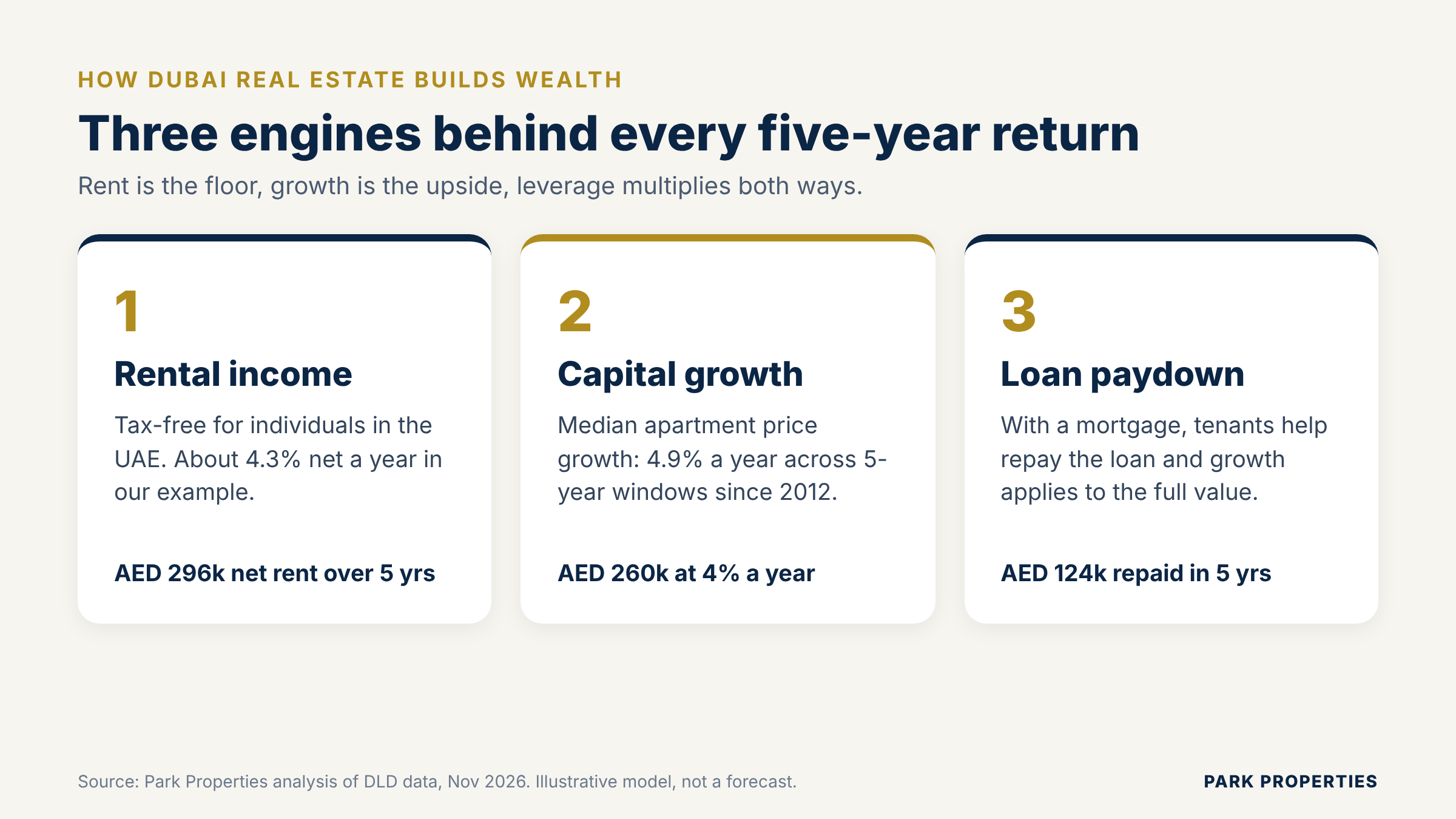
- Rental income. Dubai has no annual property tax, and rental income earned by individuals from property that does not require a business licence falls outside UAE corporate tax under Cabinet Decision No. 49 of 2023. Investors living elsewhere may still owe tax at home, so check your own country's rules.
- Capital growth. DLD data shows the median apartment price per sq ft rose from AED 1,106 in 2020 to AED 1,733 in 2025, a 9.4% annual gain. Longer history is calmer, as we show below.
- Loan paydown and leverage. With a mortgage, tenants' rent helps repay the loan, and any price growth applies to the full property value, not just your deposit.
The rest of this guide puts a real number on each engine, then subtracts every cost.
What does it cost to buy property in Dubai? (Year 0)
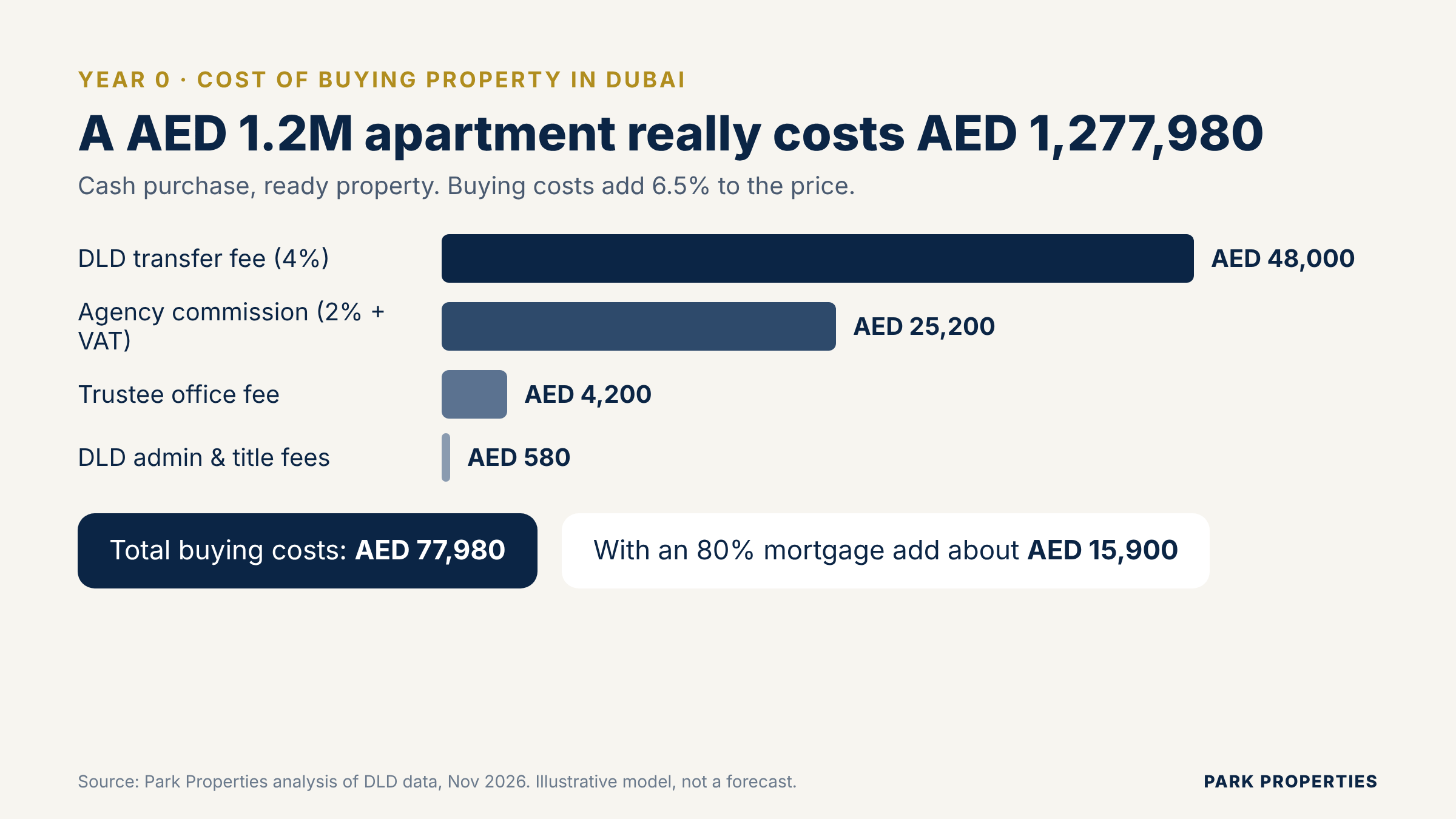
Buying a ready property in Dubai typically costs 6.5% to 8% on top of the price for a cash buyer, and more with a mortgage. The 4% DLD transfer fee is the largest single cost, followed by the 2% agency commission plus VAT.
Cash purchase costs
Here is what our AED 1.2M example apartment costs to buy for cash:
| Cost | How it is charged | AED 1.2M example |
|---|---|---|
| DLD transfer fee | 4% of the price | AED 48,000 |
| DLD admin and title deed fees | Fixed fees | AED 580 |
| Trustee office fee | AED 4,000 + VAT for properties of AED 500,000 or more | AED 4,200 |
| Agency commission | 2% + 5% VAT | AED 25,200 |
| Total buying costs | AED 77,980 (6.5%) |
That means your real entry price is about AED 1,277,980, not AED 1.2M. If you are new to the process, our step-by-step guide to buying property in the UAE as a foreigner explains each stage from offer to title deed.
Extra costs with a mortgage
Financing adds its own fees: mortgage registration at 0.25% of the loan plus AED 290, a bank arrangement fee of up to 1% of the loan plus VAT, and a valuation fee of around AED 2,500 to 3,500. On a AED 960,000 loan (80% of the price), these come to about AED 15,900.
What changes with off-plan
Off-plan buyers pay the 4% fee through the Oqood registration process instead of a title deed transfer, and usually pay the developer in stages during construction. The cash needed on day one is lower, but there is no rent until handover, which changes the five-year maths (see the off-plan section below).
Fees are set by the Dubai Land Department, banks and developers and can change, so confirm the latest amounts before you transfer.
What does it cost to own and rent out a Dubai property each year?
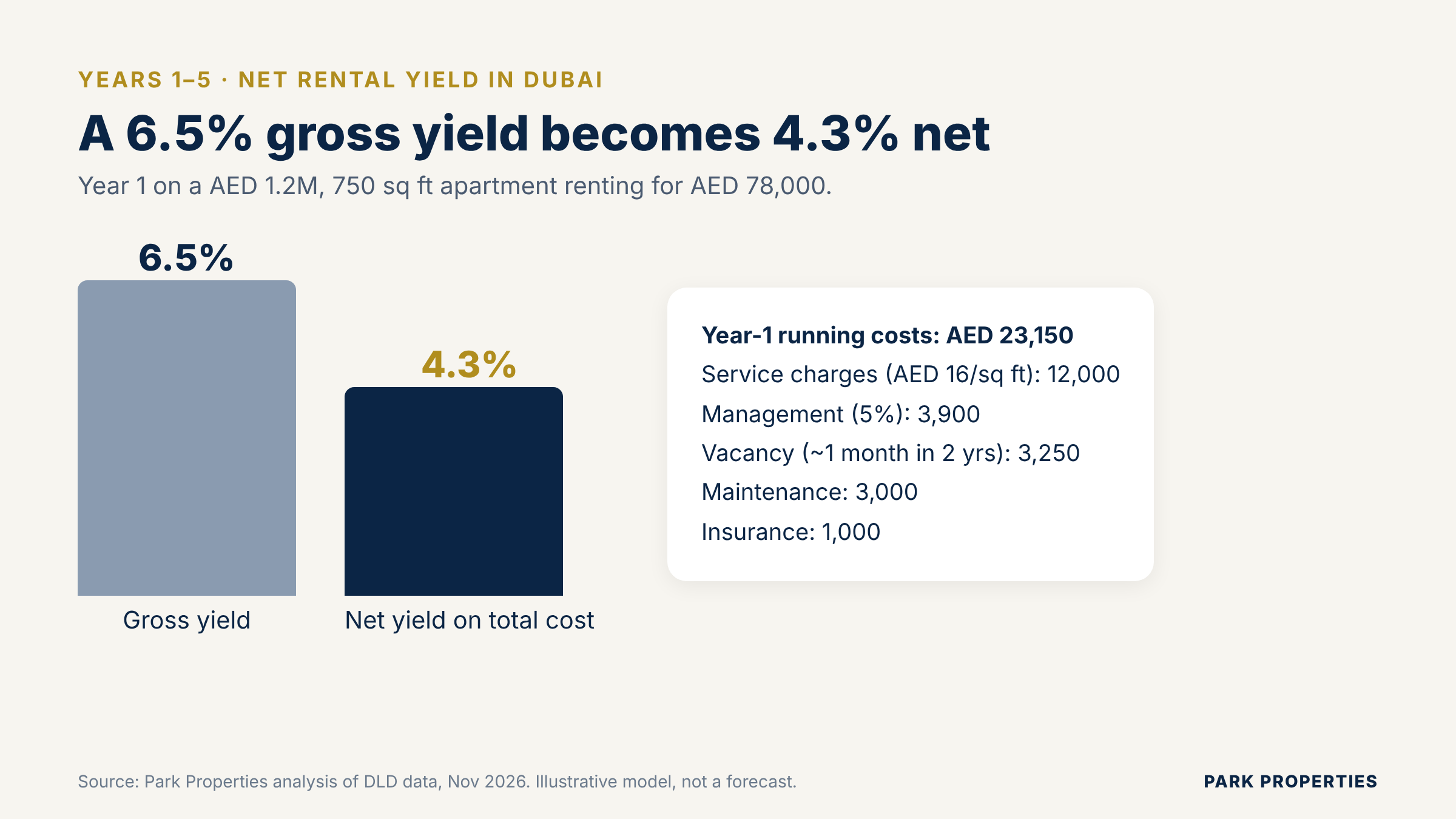
Running costs for a rented Dubai apartment usually take 25 to 35% of the gross rent. In our example they total about AED 23,150 in year one, which turns a 6.5% gross yield into roughly a 4.3% net yield on the full purchase cost.
| Running cost (year 1) | Assumption | AED per year |
|---|---|---|
| Service charges | AED 16 per sq ft on 750 sq ft | 12,000 |
| Property management | 5% of rent | 3,900 |
| Vacancy | About one month empty every two years | 3,250 |
| Maintenance and repairs | Fixed allowance | 3,000 |
| Landlord insurance | Basic cover | 1,000 |
| Total | 23,150 |
Service charges are the biggest variable. They range widely between buildings, so check the building's figure on the DLD Service Charge Index before you buy. Tenants normally pay DEWA bills, the municipality housing fee and Ejari registration.
Gross yield vs net yield
Gross yield is annual rent divided by the purchase price. Net yield is annual rent minus running costs, divided by the price plus buying costs.
- Gross yield: AED 78,000 ÷ AED 1,200,000 = 6.5%
- Net yield: (AED 78,000 − AED 23,150) ÷ AED 1,277,980 = 4.29%
For context, the average gross yield on Dubai apartments was about 6.66% in August 2026, so our example sits close to the market. Smaller units in mid-market areas often yield more, which is why affordable one-bedroom apartments have become some of Dubai's best-performing rentals.
How fast can rent grow?
We assume rent rises 3% a year, below the 4.75% annual growth in Dubai's median rent between 2020 and 2025. Dubai's rules limit how quickly landlords can raise rent on existing tenants. Under the Smart Rental Index, no increase is allowed if the rent is within 10% of the index average, increases are capped between 5% and 20% beyond that, and landlords must give 90 days' written notice before renewal.
The five-year model: one AED 1.2M apartment, year by year
Over five years, our example apartment earns about AED 296,000 in net rent, and in the base case its value rises to about AED 1.46 million. Net yield on the full purchase cost climbs from 4.29% in year one to about 5.0% in year five as rent grows faster than fixed costs.
Assumptions: ready one-bedroom apartment, 750 sq ft, bought for AED 1,200,000 in cash; rent AED 78,000 in year one, rising 3% a year; running costs as above; price growth of 4% a year in the base case.
| Year | Rent (AED) | Running costs (AED) | Net rent (AED) | Net yield on cost | Cumulative net rent (AED) | Property value, base case (AED) |
|---|---|---|---|---|---|---|
| 1 | 78,000 | 23,150 | 54,850 | 4.29% | 54,850 | 1,248,000 |
| 2 | 80,340 | 23,364 | 56,976 | 4.46% | 111,826 | 1,297,920 |
| 3 | 82,750 | 23,585 | 59,165 | 4.63% | 170,991 | 1,349,837 |
| 4 | 85,233 | 23,813 | 61,420 | 4.81% | 232,411 | 1,403,830 |
| 5 | 87,790 | 24,047 | 63,742 | 4.99% | 296,153 | 1,459,983 |
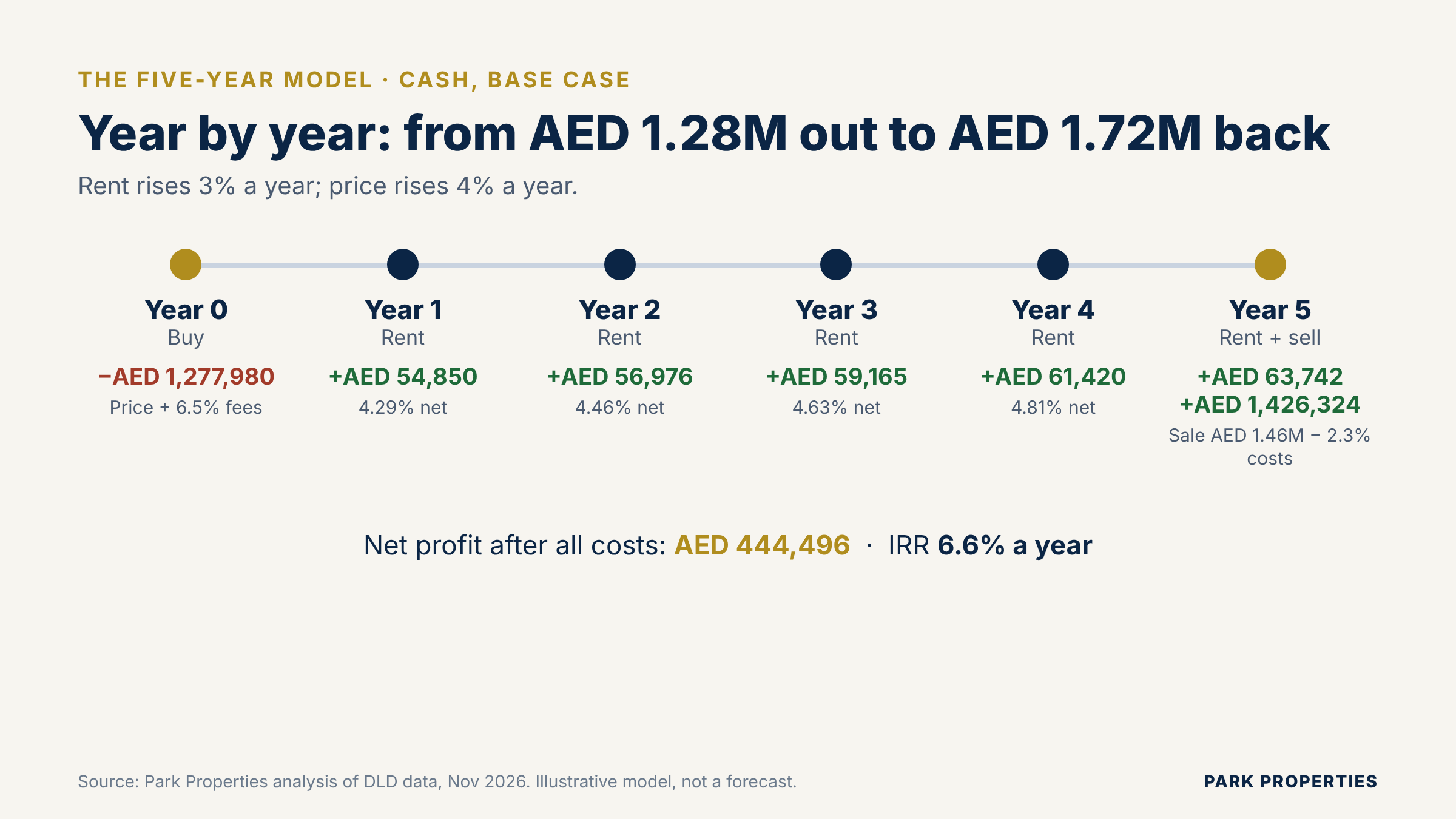
Notice that the first year and a half of net rent only pays back the AED 77,980 you spent to buy. That is why short holds rarely work in Dubai unless prices jump quickly. To see how current prices and volumes compare, our October 2026 Dubai market report tracks sales, prices and the off-plan share each month.
What does it cost to sell property in Dubai? (Year 5)
Selling a Dubai property usually costs about 2.1% to 2.5% of the sale price: 2% agency commission plus VAT, a developer NOC fee of AED 500 to 5,000, and, if you have a mortgage, an early settlement fee capped at 1% of the balance or AED 10,000, whichever is lower.
In the base case, our apartment sells for about AED 1,459,983 in year five. Selling costs come to about AED 33,660 (AED 30,660 commission and an allowance of AED 3,000 for the NOC and paperwork). For an individual investor, the UAE does not tax the capital gain, although your home country may.
Where the five-year profit comes from (base case, cash)
| Item | AED |
|---|---|
| Price growth (AED 1,200,000 to AED 1,459,983) | +259,983 |
| Net rent over five years | +296,153 |
| Buying costs | −77,980 |
| Selling costs | −33,660 |
| Net profit after all costs | +444,496 |
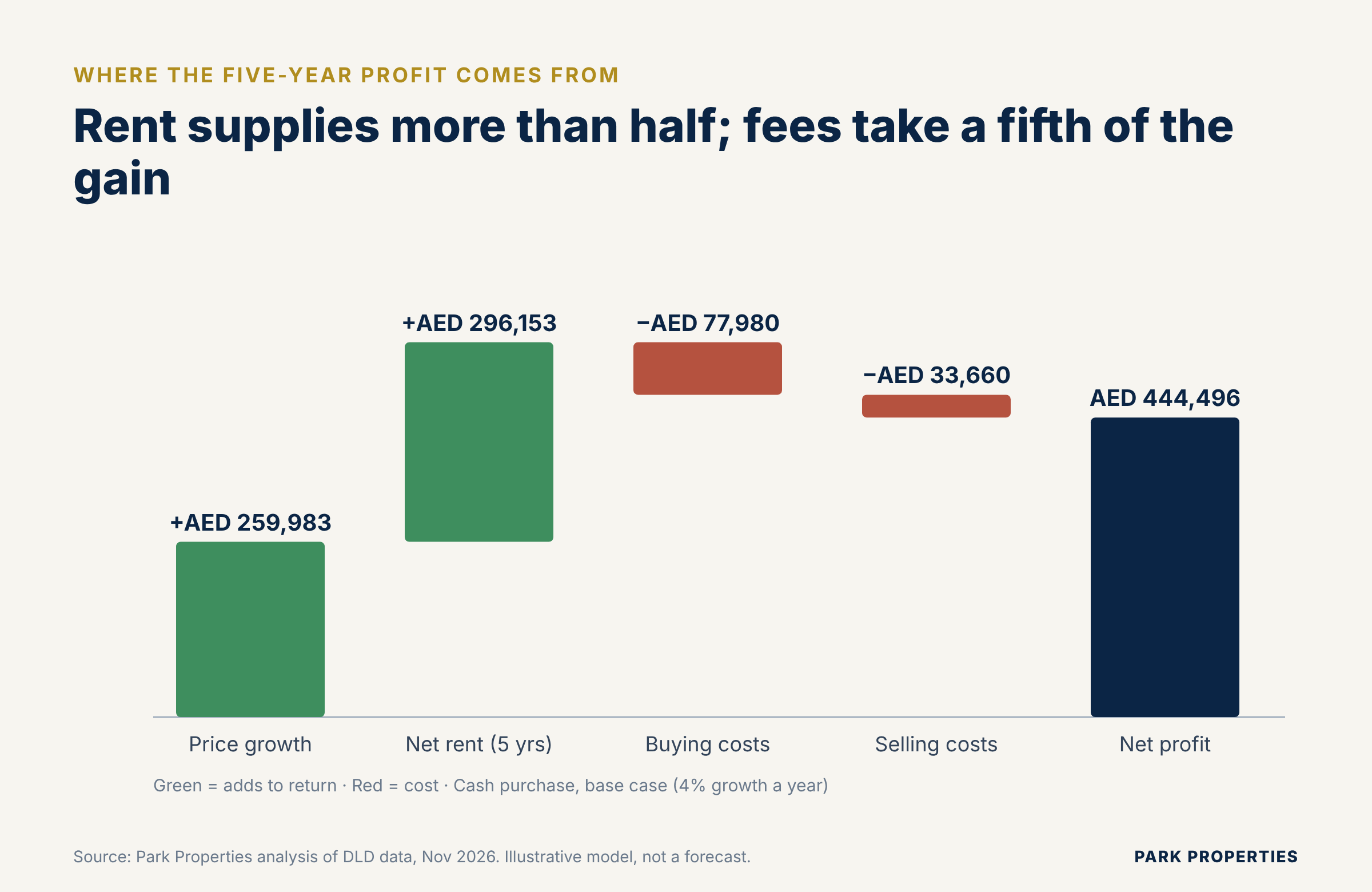
That is a 34.8% gain on the AED 1,277,980 invested, or an internal rate of return (IRR) of about 6.6% a year. Net rent supplies more than half of the profit; buying and selling costs take about a fifth of the gross gain.
How much can a Dubai property return in five years? Five scenarios
After all costs, a cash purchase of our example apartment returns between 0.4% and 10.3% a year over five years, depending on what prices do. Even with flat prices, rent alone delivers about 3.1% a year; a 3% annual price fall is needed to wipe out the profit almost entirely.
| Price change per year | Sale price in year 5 | Cash buyer: profit after all costs | Cash buyer: return per year (IRR) | Comparable period in DLD data |
|---|---|---|---|---|
| −3% (correction) | AED 1.03M | AED 24,000 | 0.4% | Similar to a 10 to 15% correction |
| 0% (flat) | AED 1.20M | AED 190,000 | 3.1% | 2015 to 2020 (0.1% a year) |
| 1% (slow) | AED 1.26M | AED 250,000 | 4.0% | 2014 to 2019 (1.4% a year) |
| 4% (base case) | AED 1.46M | AED 444,000 | 6.6% | 2017 to 2024 windows (about 5% a year) |
| 8% (strong) | AED 1.76M | AED 741,000 | 10.3% | 2020 to 2025 (9.4% a year) |
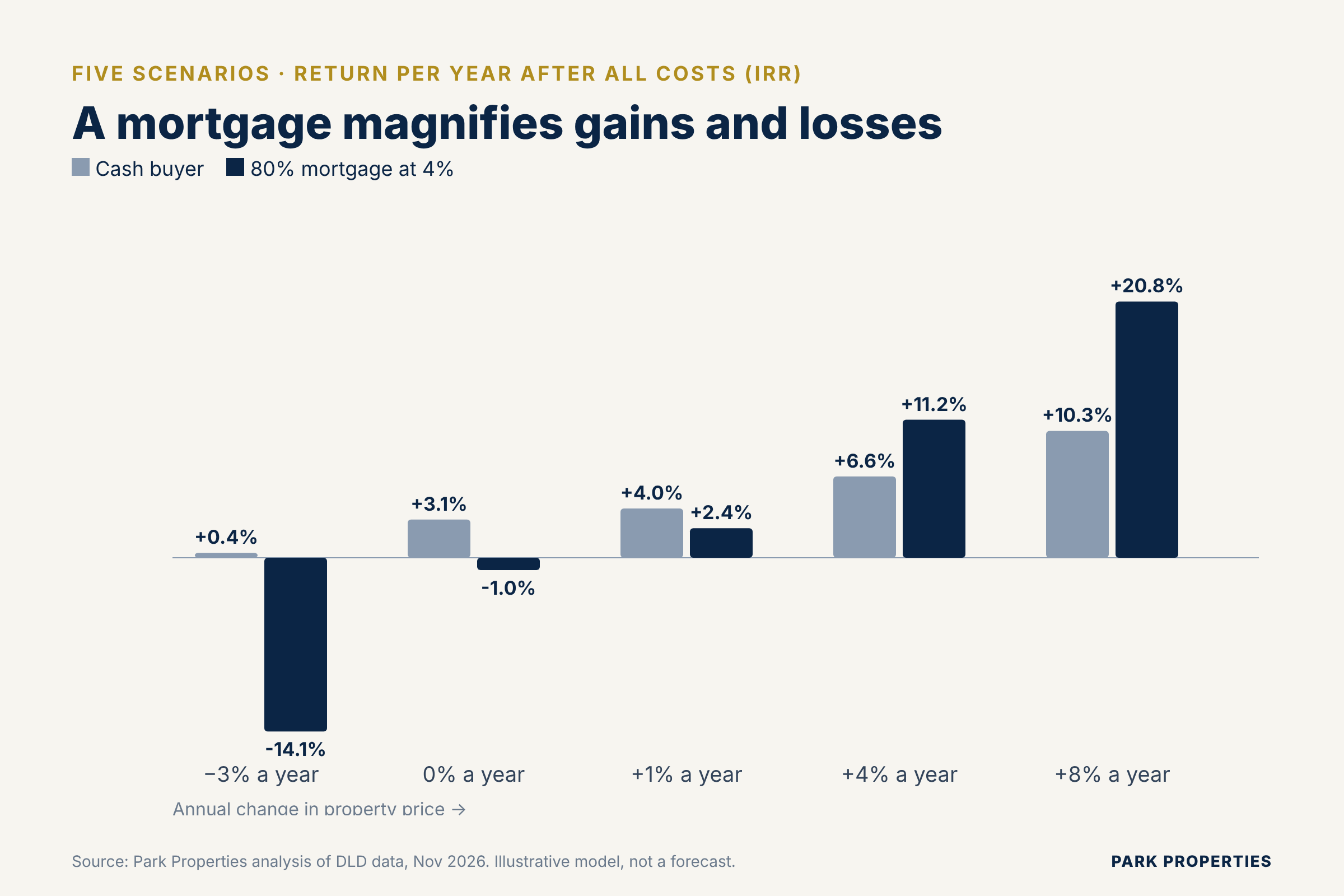
The key lesson: in Dubai, rent protects the downside and price growth creates the wealth. A property that only works if prices rise 8% a year is a speculation, not an investment. Before you buy, check that the numbers still make sense in the flat scenario.
What does history say about five-year returns in Dubai?
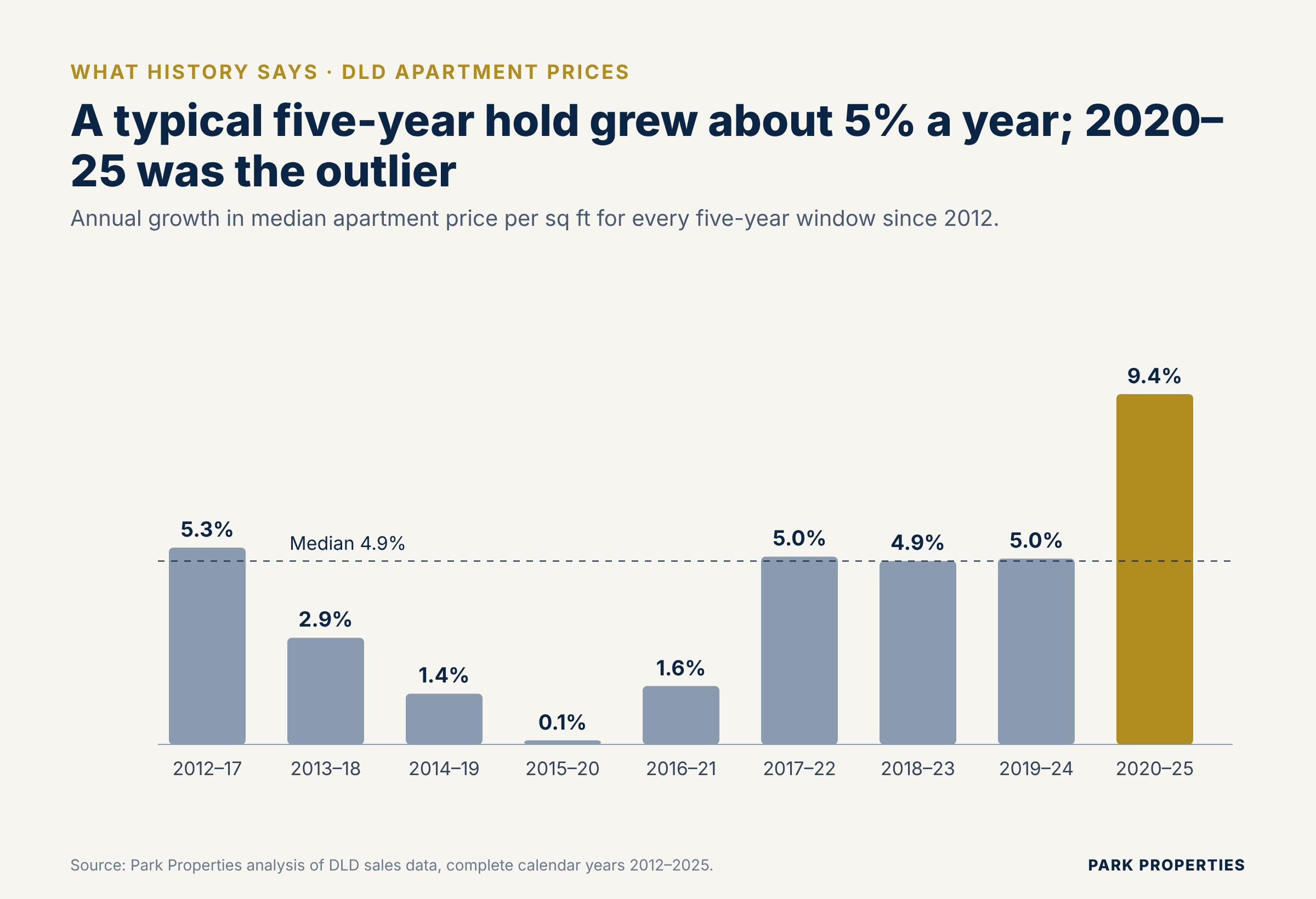
Across every five-year window from 2012 to 2025, Dubai apartment prices grew a median 4.9% a year, according to our analysis of DLD sales data. The best window, 2020 to 2025, delivered 9.4% a year; the weakest, 2015 to 2020, delivered just 0.1%.
| Five-year window | Median price per sq ft at start (AED) | At end (AED) | Growth per year |
|---|---|---|---|
| 2012 to 2017 | 927 | 1,199 | 5.3% |
| 2013 to 2018 | 1,043 | 1,201 | 2.9% |
| 2014 to 2019 | 1,201 | 1,285 | 1.4% |
| 2015 to 2020 | 1,100 | 1,106 | 0.1% |
| 2016 to 2021 | 1,102 | 1,191 | 1.6% |
| 2017 to 2022 | 1,199 | 1,533 | 5.0% |
| 2018 to 2023 | 1,201 | 1,527 | 4.9% |
| 2019 to 2024 | 1,285 | 1,639 | 5.0% |
| 2020 to 2025 | 1,106 | 1,733 | 9.4% |
Source: Park Properties analysis of DLD apartment sales, median AED per sq ft, complete calendar years. Data for 2026 to date shows AED 1,713 per sq ft, about 1.1% below 2025.
Three lessons stand out:
- The buying year matters more than the holding year. Investors who bought at the 2014 peak waited five years for 1.4% a year; those who bought in the 2020 dip earned 9.4%.
- The recent boom is the exception, not the rule. Planning on the 2020 to 2025 pace is risky; 4% a year is a more balanced base case.
- Rent carried investors through the weak years. Even in 2015 to 2020, a landlord still collected four to five years of tax-free rent.
Cash or mortgage: which builds more wealth over five years?
In our example, a mortgage beats paying cash (measured as yearly return on your own money) only when prices rise more than about 1.8% a year, and the mortgage buyer loses money if growth is below about 0.3% a year. At 4% growth, financing lifts the annual return from 6.6% to 11.2%; with flat prices, it turns a 3.1% gain into a small loss.
Here is the same apartment bought with an 80% loan of AED 960,000 at 4% over 25 years. Fixed rates in 2026 have started from about 3.75%, but we use 4% to allow for the rate after any fixed period ends.
| Item | Mortgage buyer |
|---|---|
| Cash needed on day one (20% deposit + buying and loan costs) | AED 333,900 |
| Monthly mortgage payment | AED 5,067 (AED 60,807 a year) |
| Rent minus running costs minus mortgage, year 1 | −AED 5,957 (you top up about AED 500 a month) |
| Same figure, year 5 | +AED 2,935 |
| Loan repaid over five years | AED 123,796 |
| Interest paid over five years | AED 180,238 |
| Loan balance at sale | AED 836,204 |
| Price change per year | Mortgage buyer: profit | Mortgage buyer: return per year (IRR) | Cash buyer: return per year |
|---|---|---|---|
| −3% | −AED 182,000 | −14.1% | 0.4% |
| 0% | −AED 16,000 | −1.0% | 3.1% |
| 1% | AED 44,000 | 2.4% | 4.0% |
| 4% | AED 238,000 | 11.2% | 6.6% |
| 8% | AED 535,000 | 20.8% | 10.3% |
The reason is simple: at a 4% interest rate, the cost of borrowing is close to the property's net yield, so rent alone barely covers the loan. Leverage only pays off through price growth.
Who can borrow how much? Under UAE Central Bank rules, resident first-time buyers of a ready home can usually borrow up to 80%, while investors buying a second or later property are generally capped at 60%. Non-residents typically get lower loan-to-value ratios. A mortgage can also count towards residency; see our guide to using a mortgage for the 10-year Golden Visa.
Off-plan vs ready: how does the five-year picture change?
Off-plan property needs less cash upfront and is often launched below the price of comparable ready homes, but it earns no rent until handover. Over five years, an off-plan purchase with a two- to three-year build leaves only two to three years of rental income, so more of the return depends on price growth.
| Factor | Ready property | Off-plan property |
|---|---|---|
| Cash needed at the start | Full price or deposit + fees | Booking amount + 4% Oqood fee; staged payments |
| Rent in the five years | About 5 years | About 2 to 3 years, after handover |
| Main source of return | Rent + growth | Mostly growth between launch and handover |
| Mortgage | Up to 80% (resident, first home) | Usually at least 50% paid before a bank lends |
| Key risks | Overpaying, high service charges | Construction delay, supply at handover, resale limits |
If you go off-plan, the five-year rules still apply: model the payment plan, assume a modest price at handover, and budget for snagging, furnishing and the first vacancy. Our comparison of off-plan vs ready properties covers the trade-offs in more depth, and our guide to Dubai's emerging off-plan areas shows where new launches are concentrated. At handover, a proper snagging inspection protects you from paying for defects the developer should fix.
What risks can shrink a five-year Dubai property return?
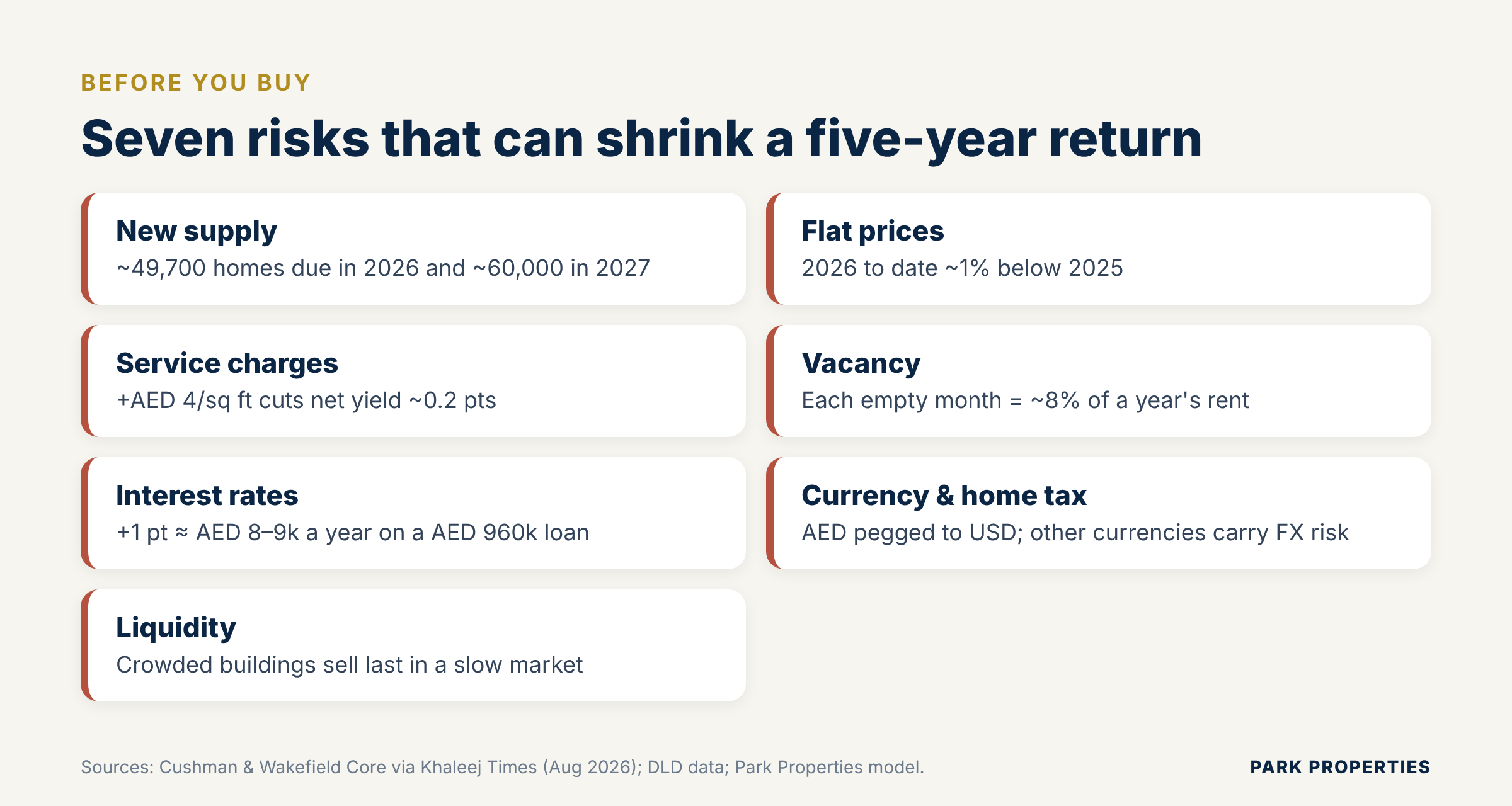
The biggest risks to a five-year Dubai investment are new supply holding back prices and rents, rising running costs, vacancy, interest rates and, for overseas buyers, currency and home-country tax. Each one is easier to manage if you plan for it before you buy.
- New supply. About 49,700 homes are expected to complete in 2026 and around 60,000 in 2027, according to Cushman & Wakefield Core figures reported by Khaleej Times. In May 2025, Fitch Ratings said it expected a moderate price correction of up to 15% as deliveries rise. Areas with heavy handovers can see slower rent growth.
- Flat or falling prices. Apartment prices in 2026 to date are about 1% below 2025 in DLD data. Our flat and correction scenarios show what that does to returns.
- Service charge increases. A rise of AED 4 per sq ft adds AED 3,000 a year to costs in our example and cuts net yield by about 0.2 points.
- Vacancy and tenant changes. Every empty month costs about 8% of a year's rent, plus agency fees to find a new tenant.
- Interest rates. For mortgage buyers, a variable rate that moves up by 1 point adds roughly AED 8,000 to 9,000 a year in interest on our example loan.
- Currency and tax at home. The dirham is pegged to the US dollar at 3.6725, which helps USD-linked investors, but buyers earning in other currencies face exchange-rate risk. Rental income and gains may be taxable in your country of residence.
- Liquidity. Selling takes time, and in a slow market, units in crowded buildings sell last.
For a fuller list of avoidable errors, read our guide to the common mistakes that cut investor returns. If you want to see how these risks look at area level, our Warsan Fourth risks vs rewards analysis is a worked example.
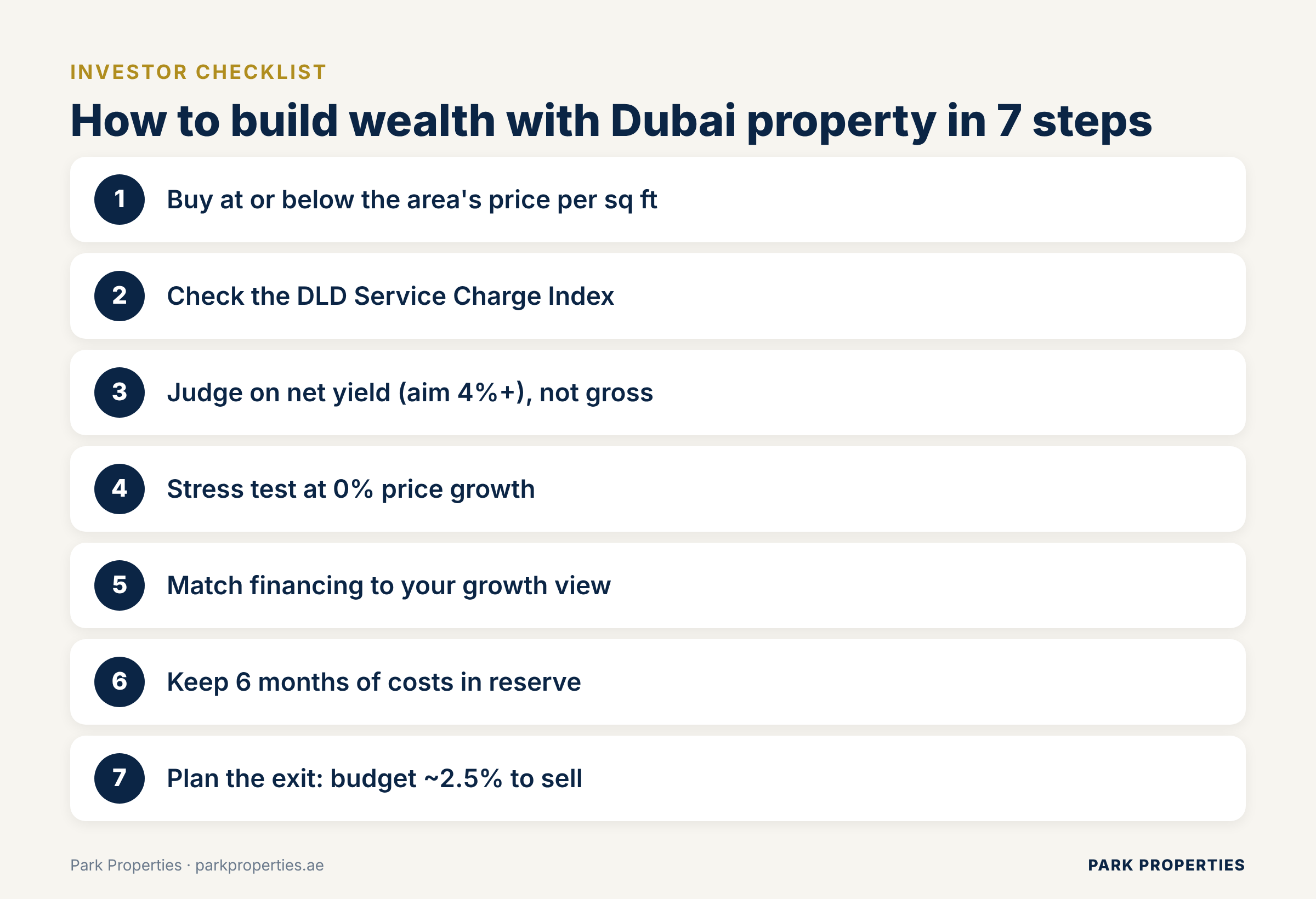
How to build wealth with Dubai property: a 7-step checklist
To build wealth through Dubai real estate over five years, buy at a fair price per sq ft, judge the deal on net yield rather than gross, test it at zero growth, and plan your exit before you sign.
- Buy at or below the area's typical price per sq ft. Compare recent DLD transactions in the same building. Overpaying by 10% costs more than two years of net rent.
- Check the service charge before you fall for the view. Look up the building on the DLD Service Charge Index and add it to your numbers.
- Calculate net yield on the total cost. Subtract service charges, management, maintenance, vacancy and insurance, then divide by price plus buying fees. Aim for at least 4% net on a ready apartment.
- Stress test at 0% growth. If the deal only works when prices rise fast, it is too tight.
- Match your financing to your plan. A mortgage helps only if you expect growth above your break-even and can cover monthly shortfalls.
- Keep a cash reserve. Hold about six months of mortgage payments and running costs for vacancies, repairs or rate changes.
- Plan the exit and the extras from day one. Know who will buy your unit in five years, budget around 2.5% to sell, and check whether a purchase of AED 2 million or more could also qualify you for the UAE Golden Visa through real estate.
Frequently asked questions
Is Dubai real estate a good long-term investment?
Dubai real estate can be a good long-term investment when bought at a fair price and judged on net returns. DLD data shows apartment prices grew a median 4.9% a year across five-year windows since 2012, and rent from property held by individuals is not subject to UAE corporate tax. Returns vary widely with the year you buy.
How much does Dubai property return after five years?
In our model, a AED 1.2M apartment bought in cash returns about 6.6% a year after all costs if prices rise 4% a year, turning AED 1.28M into about AED 1.72M. With flat prices the return falls to about 3.1% a year; with 8% annual growth it rises to about 10.3%.
What are the hidden costs of owning property in Dubai?
The main ongoing costs are service charges, property management (around 5 to 8% of rent), maintenance, vacancy and insurance. Together they usually take 25 to 35% of gross rent. One-off costs include the 4% DLD fee and 2% agency commission to buy, and about 2% plus VAT to sell.
What is a good net rental yield in Dubai?
A net yield of 4 to 5% on the total purchase cost is solid for a ready Dubai apartment. Gross yields average about 6.5 to 7% for apartments, so be cautious of any listing that quotes only the gross figure.
Is rental income taxed in Dubai?
Dubai has no personal income tax, and under Cabinet Decision No. 49 of 2023, individuals' income from real estate that does not require a licence is not subject to UAE corporate tax. You may still owe tax in your home country, so check local rules.
Should I buy Dubai property with a mortgage or cash?
In our example, a mortgage gives a higher yearly return on your own money only if prices rise more than about 1.8% a year. Cash is safer when prices are flat or falling, because a 4% interest rate is close to a typical net yield.
How long should I hold property in Dubai?
Most investors should plan to hold for at least five years. Buying and selling costs come to about 9% of the price, which takes about two years of net rent just to recover.
How much money do I need to invest in Dubai property?
For a AED 1.2M apartment, a cash buyer needs about AED 1.28M including fees. A resident first-time buyer using an 80% mortgage needs about AED 334,000 for the deposit, fees and loan costs. Off-plan projects can need less upfront, paid in stages.
The bottom line
A five-year Dubai property investment builds wealth when you treat it as a business: buy at a fair price, count every dirham of cost, and let tax-free rent carry you while prices do the rest. In our model, that means about 4.3% net rent from day one, around 6.6% a year in total if prices grow 4% a year, and a solid floor even if they do not.
The biggest mistakes come from quoting gross yields, planning on boom-time growth and forgetting the cost of selling. Get those three right and five years is a realistic horizon for real, measurable wealth.
If you want these numbers run for a specific apartment, area or budget, speak to the Park Properties team for a personalised five-year projection based on current DLD data.
This article is for general information and uses an illustrative model based on DLD data to November 2026. It is not financial, legal or tax advice. Fees and rules change, so confirm current figures with the Dubai Land Department, your bank and a qualified adviser before investing.